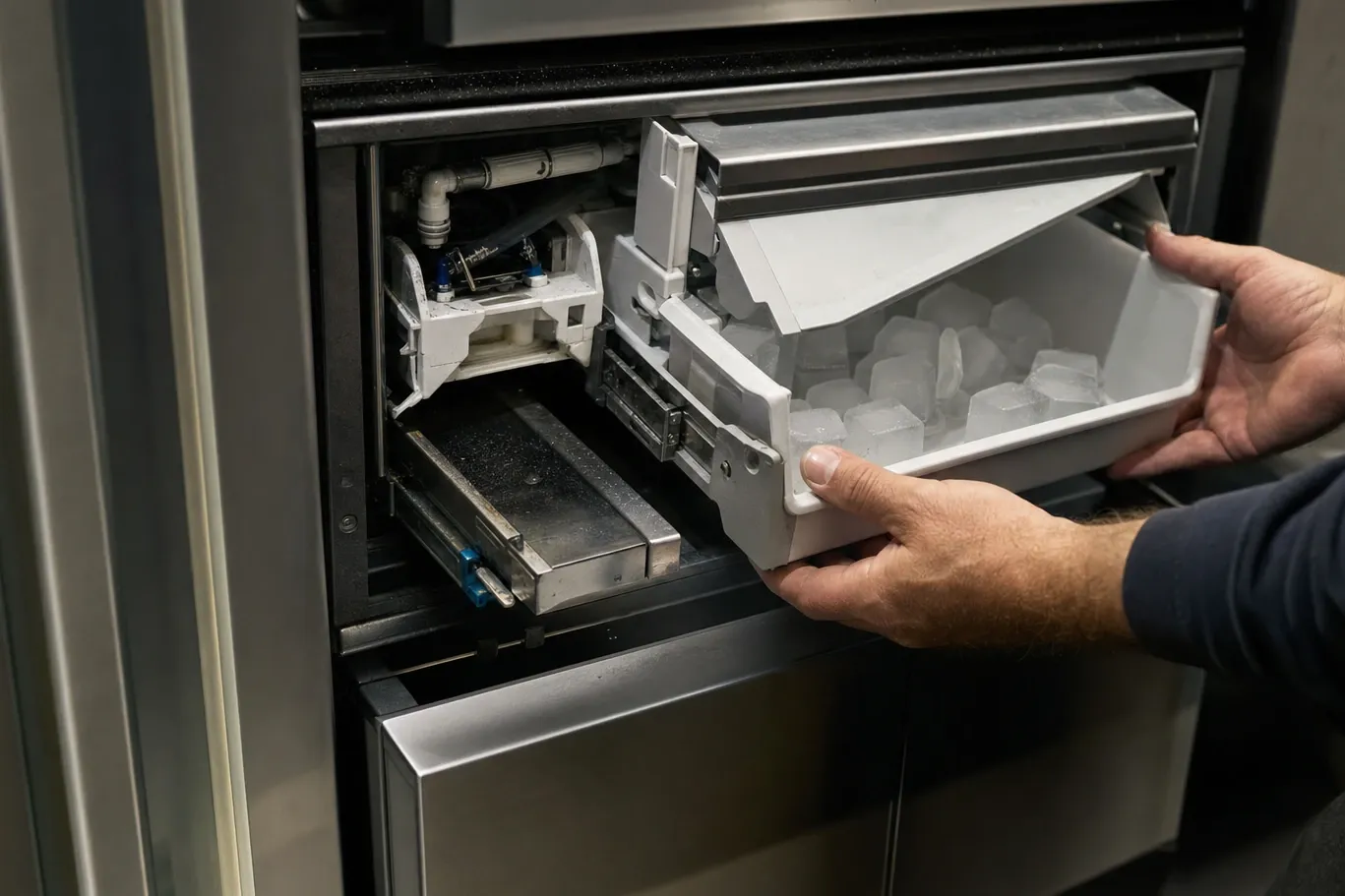
Refrigerator Repair
Farm Dust and a Warm Fresh-Food Side: The Laveen Sub-Zero Condenser Service Interval
A Laveen Sub-Zero with a warm fresh-food side and a busy-sounding compressor is usually a condenser matted with farm and construction dust, not a failed part. Here is the service interval that address needs and where the homeowner job ends.
The call we take most often here
A Laveen owner rings to say the fresh-food side has crept up towards fifty degrees while the freezer is still solid, and that the machine sounds busier than it used to. Nine times in ten on this side of the city that is not a failed part. It is a condenser that has been breathing farm air.
Why this address produces it
Laveen is roughly 48 square miles of the southwest valley that has been farmed and dairied since 1884 — cotton, alfalfa and large dairy operations along Baseline Road, including the 360-acre Cheatham dairy south of Baseline between 43rd and 51st Avenues, which closed in 2003. What makes it unusual is that the conversion is still happening. Population is up about 65 percent since 2010, and the subdivisions are arriving field by field, so a new house can sit with tilled ground on one side and a scraped construction pad on the other.
That is not a scenic detail, it is an air-quality classification. The whole of Maricopa County sits in a PM-10 nonattainment area, designated moderate on 15 November 1990 and reclassified serious on 10 June 1996, and the source categories named in that programme are precisely the ones out here: agricultural activity, unpaved roads and vacant lots. An agricultural general permit rule took effect on 12 May 2000 to control the farm share of it. When a federal air programme has to write rules about the dust at your address, the filter on the bottom of your refrigeration is going to have opinions about it too.
Two seasons matter more than the calendar average. Field work — discing, planting and harvest — puts soil into the air in a way that irrigation days do not, and the grading of a new subdivision pad next door will out-produce any farm for the weeks it lasts. Owners notice the outside of the house getting dusty. They rarely think about the appliance that spends all day pulling that same air through a coil.
The chain, from cause to complaint
A built-in Sub-Zero rejects its heat through a condenser behind the base grille, and the only thing standing between that coil and the room is an air filter. Everything that follows is one fault expressed four ways.
First the filter loads, then the coil face mats over behind it. Airflow drops, so the refrigerant cannot dump its heat into the compartment air, and head pressure climbs. The compressor answers by running longer, then by not stopping at all, and the condenser fan works against a restriction it cannot clear — that is the loaded, droning note people describe after a run of very hot afternoons.
Capacity falls unevenly, and this is the part that misleads. The freezer has the larger temperature difference to work with and holds its ground longest, so the fresh-food compartment is what drifts first. An owner sees frozen food that is fine and a milk shelf that is not, and reasonably concludes the problem is in the fresh-food side. It is not. It is at the bottom of the cabinet, in front of a coil that has stopped being a coil.
The final stage is the one worth avoiding. Months of running at high head pressure is real mechanical wear, and it is the difference between a maintenance job and a sealed-system job.
Ruling out the obvious first
Start where the air enters, because you can see it. Pull the base grille — on most built-ins it comes off by hand — and look at the filter. If it is grey and felted, that is your first answer. Vacuum it, wash it if the type allows, and let it dry completely before it goes back.
Then take a torch to the visible face of the coil. Fine soil dust does not look like household fluff; it builds as a smooth pale film that fills the gaps between the fins rather than sitting on top of them, and it is easy to miss at a glance. A soft brush and a vacuum on the face of the coil is safe and useful work. Do not push a brush deep into the fin pack and do not touch the aluminium tubing behind it — a bent fin field turns a reversible airflow problem into a permanent one.
Put a hand near the grille with the unit running. Warm air moving steadily is a working fan. Nothing moving at all, or a note that rises and falls, points at the fan motor rather than the coil.
Then give it time. A cabinet that has been struggling for weeks takes the better part of a day to pull back down after the airflow is restored, so read the temperature the following morning rather than an hour later.
Two things argue against dust being the whole story. Temperatures that drift up again within a fortnight of a proper clean, and a freezer drifting upward while the fresh-food compartment holds its number — the wrong way round for this fault, and usually the freezer circuit’s own fan or defrost.
When it stops being a homeowner job
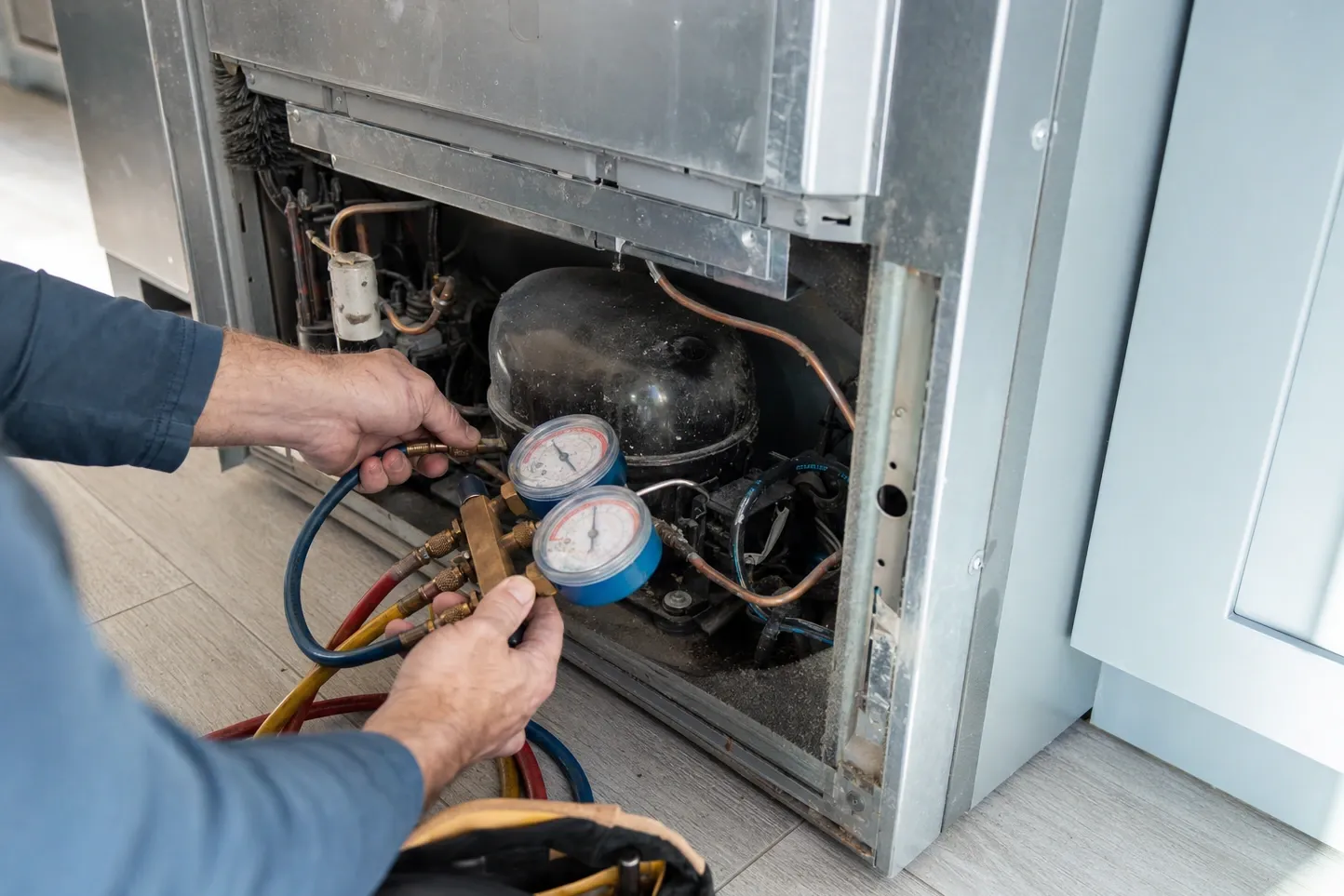
The line is simple: cleaning the filter and the face of the coil is yours, anything that needs the unit pulled or gauges fitted is ours. On a Laveen call we clear the coil properly, check the fan motor draw, read suction and head pressure, and measure both compartments against the panel.
Our diagnostic visit is $89. If the fan motor is the fault, an evaporator or condenser fan motor is $320 to $690. If the pressures say the sealed system has already given up capacity, that work runs $1,430 to $3,420 — which is the number that makes the maintenance interval worth taking seriously here.
The interval is the actual takeaway. Manufacturer guidance is written for an average house, and this is not an average dust environment: service the filter and coil on a shorter clock, and tie it to the field and construction season rather than to a date in the diary. Call (623) 240-9400 with the model plate in front of you.
Follow-up questions
- How often should the condenser be serviced on a Laveen property?
- More often than the manual assumes, and on the field calendar rather than a fixed date. Discing, planting and harvest put soil into the air, and a subdivision pad being graded next door will beat any farm for the weeks it lasts. Check the filter after each of those events and clean the coil face whenever it shows a pale film between the fins.
- There is construction on the next parcel. Will that reach my refrigeration?
- Yes, and faster than the farmland does. A scraped and graded pad produces fine soil dust in volume for weeks, and the intake sits low behind the base grille where that dust settles. During active grading nearby, look at the filter monthly rather than seasonally — it is a five-minute check that prevents the expensive version of this fault.
- The freezer is solid but the fresh-food side is warm. Does that mean the compressor is failing?
- Usually the opposite. On a single-system built-in the freezer has the larger temperature difference and holds longest, so lost capacity shows in the fresh-food compartment first. That pattern fits restricted airflow at the condenser far better than it fits a dying compressor. Clean the filter and coil face, then read the temperature the next morning before drawing any conclusion.
Past the point of a screwdriver? The refrigerator repair page sets out what a visit involves, or call (623) 240-9400.